

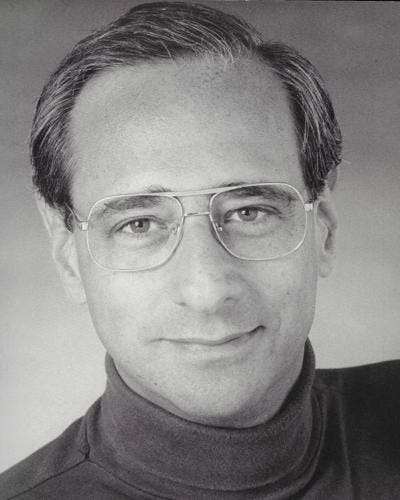
My old friend Richard Mandel, who died on October 5, was unique in at least one respect: He instinctively grasped the link between leadership and humor. Conventional wisdom holds that if you want to be taken seriously, you must appear serious. But conventional wisdom is often wrong, as Richard demonstrated throughout his 84 years.
Most Philadelphians remember Richard as a progressive educator who led the Miquon School from 1975 to 1984 and Friends Select from 1984 to 1991, bringing to both institutions an approach that encouraged students to think for themselves and explore their individual curiosities.
But when Richard and I were junior high school classmates at the Fieldston School in New York, he was the class clown. He did excellent imitations of Carl Reiner and Shelley Berman, not to mention many of our teachers. The teachers, who did not always appreciate his antics, were constantly tossing him out of class to stand alone in the hall. After one such ejection, Richard told me years later, he experienced an epiphany, asking himself, “What am I doing out here like a jerk?”
In ninth grade, as I recall, Richard wrote in a huge, childish scrawl and could barely spell his name. Through high school, he was the life of every party and the star of our class plays, as well as the author of hilarious parodies of our classmates’ prose and a “Dear Flossie” advice column, both written for a rexographed underground class newspaper I published. But nobody took him seriously. His role in any situation always seemed that of the big, lovable buffoon.
Saved by Vietnam
Of course, many an adolescent has been transformed when released from the stereotyping of his peers, and Richard was no exception. To the great surprise of his high school classmates, Richard went off to the University of Chicago, where he was elected president of his dorm council, made the dean’s list, and then breezed through Harvard Law School. The real Richard Mandel had finally emerged— or had it?
After earning his law degree in 1967, Richard was headed for a prestigious New York law firm. Had he taken that job, he would have wound up with a six-figure income, three-piece suits, and three-Martini lunches at private clubs. He also would have been miserable— because, it turns out, the fellow I knew in school was the real Richard Mandel after all.
Luckily (for him), in 1967 the Vietnam war was at its peak. At 25, Richard had only a year left to put himself beyond the reach of the draft. The prospect of spending that year blowing up palm trees to save democracy didn’t appeal to him. Neither did any of the draft-deferable options in the law, such as doing legal work for a branch of the service or for a defense contractor. So he decided to spend that year teaching.
Which job satisfies?
He got a job at Palfrey, a fledgling alternative high school in a Boston suburb, one of those free-form places where the curriculum is pretty much left up to the individual teachers. Suddenly, he found his creative juices flowing again. On Sunday nights, he told me, he could hardly sleep from excitement about returning to the school and his students.
From there, he spent three years as assistant to the president of the Baltimore city school board, joining a group of late-’60s idealists who had come to Baltimore to perform miracles in urban school education. Then he spent three years at Penn’s graduate school of education, running a program funded by the Ford Foundation. Next, he spent a year as a visiting professor at Temple Law School. By this time, eight years out of college, Richard had had a variety of work experiences, and he made a conscious effort to analyze which ones satisfied him.
He concluded that his greatest pleasure came from small groups whose members provided each other with support, mutual respect, and esprit de corps while working intensely on a task. And if those characteristics were present, it didn’t really matter what the task was. What mattered to him, he realized, was not so much a particular field as a kind of environment: one in which interesting, intelligent people related in some intense and productive manner toward the achievement of a common goal— any common goal.
No credentials, but…
So it was that my old friend Richard became principal of Miquon, a small private elementary school just outside Philadelphia, one of those unstructured co-ops started by parents who were dissatisfied with the public schools. In such a loosey-goosey environment, the school principal was not so much a policy maker or disciplinarian as an instrument of support and encouragement for teachers, parents, and children alike.
“We chose Richard,” a member of the selection committee told me, “because he was well organized and could deal with money, but mostly because he had a good sense of humor. That is needed above all else, precisely because Miquon has so many people who feel so strongly about what they’re doing.”
Richard had never been a principal before, and several candidates for the job had more impressive credentials on paper. But in the last analysis, several committee members told me, no other candidate came close to him.
When I visited Richard at Miquon in 1976, I found him dressed not in a three-piece suit but in a sweater, corduroy slacks, white woolen socks, and hiking boots. As we walked around the grounds, a kid skipping past us shouted, “Hi, Richard!” When Richard and I were in school, we would never have dared to say, “Hi, Luther!” to our principal; we hardly even ventured to call him “Mr. Tate.” He seemed such a distant figure that whenever he came into view, the students simply vanished.
Years later, after graduation, we learned that Mr. Tate was really a very sensitive and gentle man who may have seemed unapproachable but was in fact simply shy. He ran a remarkable progressive co-ed school amid the conformist/Eisenhower 1950s. Now that he is gone, I wish I had known him better. Richard’s students should have no similar regret.
Diffusing tension
When I attended an evening meeting of Miquon parents, Richard sat on a stool, his legs crossed, looking every bit like the Shelley Berman imitation he used to do in ninth grade. And as the evening progressed, it became obvious that his old high school stage presence— his good sense of timing and dropping a punchline— still served him in good stead.
Several parents discussed what, if anything, the school should do to ease children through the separation or divorce of their parents. Someone suggested that the school shouldn’t meddle in a family’s private business. The discussion proceeded until Richard attempted to sum things up.
“We would never,” he began, “invade a family’s privacy for the sake of…” He paused, searching for the proper word.
“Prurience,” someone suggested.
Richard frowned thoughtfully. “Well,” he said slowly, “for prurience, we might be willing to do it.” The group laughed, and then he took another pause.
“I don’t know if I’m putting my foot in my mouth, or if other people are putting it there for me.” More laughter.
Just as he did in high school, Richard was instinctively casting himself as the buffoon. But there was a method at work here that my fellow Fieldston classmates and I didn’t see back then: By heaping ridicule upon himself, Richard was putting everyone else at ease, diffusing what might otherwise be a tense situation.
School bus crisis
Later in that meeting, a parent raised another touchy matter. It seemed that some of the older children on the school bus were offering bags of M&Ms to the younger kids as an inducement to drop their pants and expose themselves. Again, the problem bounced back and forth among the parents; again, the discussion faded after a few minutes as the parents awaited Richard’s response.
“I don’t know what to say,” he offered, perplexed. “My first reaction is— can we find a way to put this to work for annual giving?” A few days later, he spoke to the boys involved and, while they denied responsibility, the problem apparently evaporated.
That situation and its handling reflected rather accurately both the philosophy of Miquon and Richard’s career: Relax. Don’t push the river. Just give it a gentle nudge from time to time, and things will work out for the best. Who should know that better than my old friend Richard?
Bar Mitzvah at 53
Richard was never afraid to reinvent himself. After his two stints as a headmaster, he joined a couple of Philadelphia theater companies as an actor. At 53, he became a bar mitzvah. He later founded the men’s Torah study group at the Germantown Jewish Centre and led it for 24 years. He continued to work as a consultant to schools. In his last years, he turned to writing a memoir of his early life. When our Fieldston class held its reunions, we usually turned to Richard as the prime organizer. As Richard discovered when he first set out years ago, ultimately what mattered was not what he was doing, but with whom he was doing it.
He was such a vital life force that I can’t quite believe he’s no longer with us. And the ultimate lesson of his life? François de La Rochefoucauld said it in the 17th Century:
“The man who lives free from folly is not so wise as he thinks.”
Enjoy Dan Rottenberg’s newest book, The Price We Paid: An Oral History of Penn’s Struggle to Join the Ivy League, 1950-55. You can also visit his website at www.danrottenberg.com
I loved this. Your best yet, I think.
This one was especially wonderful, Dan